Preservation Month…See! Save! Celebrate!
It’s May, so you know what that means: Preservation Month!
This year, the National Trust for Historic Preservation has chosen the theme “See! Save! Celebrate!” to help spur the creative juices when it comes to highlighting preservation in your community. Here are three ways you can recognize Preservation Month in your community using the Trust’s theme.
See! Architectural Scavenger Hunt
What better way to get your residents to take a fresh look at your historic resources than by holding an architectural scavenger hunt? Long-time residents may see your historic neighborhoods in a new light, and new residents may be interested in a fun activity such as this to learn more about a community’s special buildings.
The idea is to identify unique architectural features that make your historic buildings special (elaborate window designs, stained glass transoms, intricate cornices) and then to publish a guide of the features. Contestants then investigate the neighborhood to match the feature to the building and its location, and enter a drawing for a prize. The prize doesn’t have to be especially elaborate. A popular item I’ve seen is gift certificates to community businesses for the winner.
Save! Hold a special lecture on the importance of historic preservation
Whether you’re focused on the benefits of preserving historic wooden windows, or the architectural history of your community, preservation at its heart is about preserving the special, unique qualities of our built environment. Your historic buildings and neighborhoods are absolutely unique to your community, and your residents will care so much more about your historic stock when they learn what it is about a building’s architecture and history that makes it unique.
In Main Street we’re always selling the importance of using existing assets as the foundation of building a great revitalization program, so let people know about your historic assets. What exactly provides the character that makes your town unlike any other? An old building that’s just known as an old building is too easy to forget and neglect, but a building with stories and architectural character can become a landmark and a source of preservation pride.
Celebrate! Recognize your community’s preservation accomplishments with an awards ceremony
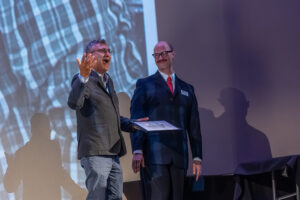
Recognize recent building rehabs, tireless volunteers, and leadership organizations with a special ceremony, giving your recipients a chance to take a victory lap in front of their peers and neighbors. Preservation Awards hardly ever include a cash prize, but that’s ok because public recognition is a powerful way to say “thank you” to someone who is raising the profile of preservation in your community.
To add some weight to the awards process, look at partnering with another entity. For example, the Michigan SHPO partners with the governor’s office to present the “Governor’s Awards for Historic Preservation.” The ceremony is held at the state capitol and you can bet recipients feel honored to be recognized in such an important setting.
Heritage Ohio is celebrating May as Preservation Month in a couple different ways. We’re holding our annual photography contest (and we’ve extended the deadline for entries to May 24), and we will honor the best accomplishments in preservation & revitalization at our Annual Awards Luncheon on May 23, during our annual conference. We hope you’ll submit a photo, join us in Columbus at our Annual Awards Luncheon, or participate in a local Preservation Month activity as we all work to raise the profile of preservation in Ohio.
How to Save a Building
It’s interesting to work in a field where most of the people I interact with don’t “work in my field.” I am constantly being asked to speak about how to save a building or how to research a building for a National Register Nomination, and ultimately why would you do a National Register Nomination. By no means is this an exhaustive list, it is intended to provide a framework that will allow Heritage Ohio, Ohio Historic Preservation Office, and other organizations better assist you as you try to save a building in your community.
Saving a Building 101
I will immediately ask you three things: 1. Who owns the property? 2. What is the significance of the property? 3. What legal steps have been taken?
Who Owns the Property
Is it privately owned or publically owned? Is the owner willing to work towards saving the property? Owner consent is vital. If it is privately owned, the owner must be cooperative or open towards saving the property. Public ownership is when the city or county have control over a building.
How to find out who owns a property – Many resources are available for free and online to determine ownership of a property or building. County Auditors websites have searchable databases that provide information on a specific address over time, allowing you to see who currently owns the building as well as any previous owners. Example:Columbus County Auditor Property Search
What is the significance of the property?
Is it architecturally significant? Connected to a specific person or place in history? Is it part of a broad national context?
How to find out the significance of a property: the National Register database is searchable by county, city, property name, address, as well as many other fields. This is a quick way to determine if the property already has a National Register Nomination. Example: Ohio Historic Preservation Office/National Register Searchable Database
What legal steps have been taken?
Has there been a building study? Have the courts condemned the building? Is there a demolition date?
Property rights are well protected in America. National Register properties are not protected from demolition, and ultimately the owner has the final say whether private or publically owned.
From here Heritage Ohio and other historic preservation organizations can help determine the best scenario moving forward.
Who to contact? Local governments may have a design review committee or a preservation coordinator. Also local cities may have an Ohio Main Street program or Local Preservation Organizations who can help. At the state level, the Ohio Historic Preservation Office and Heritage Ohio can help guide you in the right direction based on the answers to the above questions. Finally, at the National Level there is the National Trust for Historic Preservation.
Adaptive Reuse
Once the building has been saved (or in many cases just saved from immediate demolition) the next step is finding a viable use. We call this Adaptive reuse. Each community needs to evaluate the needs of their community to determine the best fit for not only the building but the area.
As with all business ventures, a business plan is essential. The idea has to be financially viable today and in the long term.
When searching for an adaptive reuse project, there are three areas to be thinking about:
Initial Purchase/Investment If publically owned, is it possible to have the property donated? If privately owned, is the owner open to negotiation on the asking price? Be prepared for upfront costs associated with assuming ownership of a building.
Keeping the Lights on. As an organization, you need to be able to keep the lights on in a building for a minimum of 5 years. What does that electric and heating cost come to? Are there any administration fees available?
Rehabilitation Costs. Often times historic buildings need to be brought up to building code around the time of a title change or purchase. You need to be aware of the cost of upfitting a building even to the base minimum building code. Also, many times an organization needs to find a developer to take on the project. There may be significant fees associated with this.
Finally, your organization needs a way to pay for these costs and services. Forming a non-profit is one option. The benefits of being a 501c3 nonprofit are the ability to accept funding and grant money from public and private sources. The Ohio Historic Preservation Office has many grants and funds for “bricks and mortar” which refers to actual building and construction expenses, such as fixing a roof or bringing the electrical work up to code. One program is Ohio’s History Fund. However, you need to legally be able to accept public funds. If you don’t have any organization willing to help, you will have to become a nonprofit yourself.
While this is only the beginning steps to saving a historic landmark in your community, it provides a strong foundation in order for Heritage Ohio and other historic preservation organizations to assist your project.
Enter our Preservation Month photo contest!
Happy Preservation Month to you! Each May preservation organizations across the country, including Heritage Ohio, celebrate historic preservation with special events and activities. Our Preservation Month 2013 Photo Contest will focus on Saving Ohio’s Treasures. We want to see you with the places that matter in your life and the places you want to see preserved for future generations of Ohioans. We’ve created a special sign for you to hold in your photos, which you can print off from our website.
We’ll accept entries through Friday, May 24, choose our finalists, and open the online voting for the winner on May 27. Online voting closes on June 3 and we’ll announce the winning entry on June 10.
Some guidelines to remember:
- The subject matter of the photo must be physically located in Ohio
- Judging criteria for choosing photo finalists include originality, subject matter, and artistic merit
- Photos should highlight historic locations that merit being preserved as an Ohio Treasure
- We also encourage photos depicting historic buildings in use
Again this year, we’ll feature the winning entry on the cover of Revitalize Ohio, so here’s your chance for Ohio photographic fame. Good luck!
A tale of two schools
As preservationists, we constantly fight the misconceptions and notions that people have about continuing to use existing buildings, or rehabbing buildings that have been vacant. I came across one such example a few weeks back in the Record Herald, Washington Court House’s daily newspaper.
The headline read “Jeffersonville school to be demolished soon” and the article briefly recounted the impending demise of a small-town school building. Quoted in the article, the county’s chief building official provided arguments about why the demolition, for a 1924 school building that had been vacant since 2008, was needed.
Demolition argument #1: the cost of retrofitting
“Usually those old buildings with the way they were built…we’re not able to retro-fit them with new mechanical things. The cost is just overwhelming.”
Demolition argument #2: since the building has been vacant for a period of time, demolition has inevitably become the only choice
“Sooner or later (old buildings) do become a hazard…It can’t go anywhere but down the longer it sits.”
What’s ironic is the last sentence of the article, discussing the site’s future once the school has come down:
Ideas being discussed for the future of that site include an apartment building and/or possibly a small park.
Now, let’s contrast the demise of the Jeffersonville School with the rebirth of the Hawthorne School in Dayton, a historic school building currently in use as, surprise, apartments!
Built in 1886 in McPherson Town, a picturesque Dayton neighborhood, the school served as an educational hub until 1974 when the district abandoned the building. The building served other purposes but was completely vacated in 1987, its age beginning to show. Although developers showed interest in the building, no viable proposal came forward until 1998 when the building was finally rehabilitated into residential apartments. In other words, the building sat vacant and in disrepair for 11 years before it was successfully redeveloped.
The redevelopment was a true public-private partnership as both the City of Dayton and the private developer brought their respective tools to the table: private equity, tax credit incentives, a city loan, HOME funds, and CDBG funds. The result still stands today: a historic apartment building that adds to the fabric of a historic neighborhood.
When comparing these two paths, what really stands out is the community mindset when making a decision about a vacant building. Does the community view the building as an asset to invest in, or does the community view the building as a liability. If these two schools switched communities, do you think the results would have been different: the Hawthorne building preserved in Jeffersonville, and the Jeffersonville school demolished in Dayton, because of the qualities of each building? Or is it the community mindset (and will to preserve) that ultimately signs a building’s death warrant, or grants its rebirth?
As our annual round of Top Preservation Opportunities comes up again this year, we hope to once again reach out to the “Jeffersonvilles” of Ohio and influence (and educate) the mindset of the historic, but vacant, building as a liability, to become a mindset of the building as asset. We’ll let you know what happens.
How to Research a Historic Building or Site
In my field I am confronted with two main challenges:
1. How do you research a historic building or site?
2. How do you save a community landmark?
Today, I am tackling how to research a historic building or site. Recently, Andrew Neutzling, Americorps Volunteer with Columbus Landmarks, and I gave a lecture to a graduate class at Kent State for Library Science and Genealogy students on this topic. We outlined the main primary resources we use in Ohio on a daily basis, along with who to contact for assistance and a primer on architectural history.
I have attached our presentation in pdf form with links to websites and examples of architectural essays, Ohio Historic Inventory forms, and National Register nominations.
Stay tuned for May 8 when I will tackle part 2: How to save a community landmark.
Christie Chapman
Americorps Volunteer with Heritage Ohio
cchapman@heritageohio.org
Downtown Findlay Hiring Program Coordinator
Downtown Findlay – Program Coordinator
Downtown Findlay (OH) is embarking on the Main Street program and is seeking a full time program coordinator to lead the effort. The on-site staff person is charged with developing, organizing, implementing and documenting the Main Street approach through the Alliance and its divisions (Economic Development, Chamber of commerce, Convention & Visitors Bureau) http://www.findlayhancockalliance.com/DowntownFindlay/downtown.aspx . He/she will be responsible for managing relations with and focusing the work of business owners, property owners, committee members, volunteers to accomplish the goals and objectives of the annual work plan. Those interested should submit their interest and resume to info@FindlayHancockAlliance.com on or before Monday, April 15. The position is full time and includes benefits.
What I Learned About Streetscape Construction Projects
Last week I spent an afternoon with the City of Painesville Economic Development Director and the Downtown Painesville Organization Executive Director. We were out meeting with business owners to discuss the upcoming streetscape construction project scheduled for this summer.
I learned a great deal regarding streetscape projects and what it takes to prepare for a project. It seems the main theme of the day was communication. The Painesville representatives have already done a great job of communicating the details of the project with the business owners. Projects like this are enormous undertakings and have so many moving parts that they can be hard to keep under control. While city leaders and downtown folks are typically very excited about these projects, they can be very daunting for business owners and it is imperative that they are kept in the loop. In Painesville, the business owners were contacted early regarding the project and given some rough ideas what to expect. When plans were complete, business owners were visited and construction plans were reviewed in person. This gave the business owners a chance to understand the process and how it would impact them, it also gave the city and downtown representative a chance to hear property owners concerns and address any questions. This also gives the project leaders ample time to make adjustments to suit the business owners and address concerns.
Business owners were informed when the construction would take place and how it would impact them. These impacts included reduced parking, reduced store visibility, increased noise and dust and reduced customer access. By better understand when and what was taking place, business owners are better able to prepare. Preparation most often included communication with customers to make them aware of the impending construction and let them know the store would be open, or in some instances have them enter the store from the rear. Some business owners were also making plans for temporary signage, changes in lighting or valet parking.
We also discussed the importance of finding the right contractor for the project. There are plenty of horror stories from other towns where a contractor was not sensitive to the needs of business owners and communicated poorly. In one of the worst cases, this situation lead to business owners suing the city over lost revenue during construction. Finding a contractor that has experience with streetscape construction is a must. This contractor must be willing to do the project in phases and try to keep the impact on business owners to a minimum. The contractor must also be willing to communicate on nearly a daily basis to keep everyone informed on the progress of the project.
Streetscape projects can and should be a tremendous benefit for a downtown or commercial business district, but if mismanaged, can be a potential debacle. I was very appreciative of the time I spent with Jen Reed and Cathy Bieterman of Painesville. I learned a great deal about what it takes to prepare for a streetscape project and feel confident that Painesville’s project will run smoothly. As always with Main Street Communities, advice and suggestions were shared from communities that have already been through the process and Painesville will share their experience with cities going through the process down the road.
Still, Downtown is the Best Community Investment
Every month, ever year, since 1998, we have required the Ohio Main Street Communities to submit monthly reinvestment statistics. We do this because we stand behind the Ohio Main Street Program and we know the numbers will justify the effort. We also do it, so when we seek new legislation from our state legislators, we can prove the impact of downtown revitalization. The Ohio Main Street Communities use these figures to garner local support and for their own advocacy efforts.
In 2012, 26 Ohio Main Street Communities reported their reinvestment statistics. There were 104 facade improvements undertaken, totaling over $5 million. Eighty buildings were rehabilitated at the cost of amost $15.5 million. Over $40 million was invested in new construction in these districts and 44 pubic improvement projects added another $2.8 million to the totals. Two hundred and eight new business opened adding an additional 536 full-time employees and 600 part-time employees. Amazingly 84,536 vollunteer hours were logged in these 26 communities. The total investment was over $63 million. Considering the average Main Street budget of around $130,000, for every $1 invested in a Main Street Program, there was $18 reinvested in the district.
When we compile the numbers from 1998 to 2012, they tell a pretty amazing story of the impact of the Main Street Program. Ohio Main Street Communities have added over 1000 net new businesses. Those businesses have created over 4,000 net new full-time jobs and over 3,000 net new part-time jobs. A stunning total of $821,738,306 has been invested in these districts. More than 660,000 volunteer hours have been donated to these organizations which is valued at $12,454,200. Other economic development programs would be hard pressed to boast such numbers as 1 new full time job for every $8,500 invested. The average investment per community is almost $2.5 million and that for every $1 invested in the local budget, $23 is reinvested in the district.
These statistics are a testament to the power of the Ohio Main Street Program. When considering we have experienced two recessions in the last fifteen years and the last five have been historically bad, we can unequivocally say, downtown revitalization is an investment every community should make.
The Sweetest Things About Historic Preservation- Happy Valentines Day Preservationists!
1. The long forgotten buildings. I can’t get enough of touring decrepit forgotten pits on the verge of falling down, they all have a story, a history, people who built them, people who occupied them, the joys and sorrows expressed there. Who turned the key the day it was shuttered and walked away for the last time?
2. The rehabilitated buildings. I can’t get enough of touring the restored buildings, by the people who brought them back to life, the pride, incredible artistry and ingenuity once abandoned now restored. Places reborn for a new generation express so much hope and optimism.
3. Historic Theaters. I enjoy a lot of building types: barns, courthouses, schools, etc., but I do have a special soft spot for historic theaters. Theaters need the drama that historic interiors provide whether for music, cinema, or theater…they transport the experience of entertainment.
4. Historic Tax Credits. I will always support the incentives that put buildings back in circulation adding to our economy. I want to recruit new building owners to take advantage of the 10% or 20% federal credit and the 25% Ohio credit. You can do it!
5. Architects. The professionals with the vision to see what can be, and draw the vision so the rest of us can see it too. (and my husband is an architect -so I am sweet on him)
6. The Hidden Materials. Treasures uncovered! When old wallpaper is revealed or the scars of an old stairwell, the old light fixtures found in the attic, is that discovery not just the sweetest feeling ever?
7. Heritage Tourism. I have never traveled anywhere that I wasn’t checking out the houses, popping into public and commercial buildings just to see what is inside. I do plan my vacations around unique places to visit because they have retained integrity and inspiration.
8. Preservation Organizations. Whether local, national, or a statewide preservation organization, we are all working together so that we will have stronger cities, states and a stronger nation because we know who we are and we know our sense of place.
9. Main Street Approach. I can’t get enough of visiting our Main Street communities and meeting the volunteers and managers who give their heart and souls to their community, banding together to make their town a special place, they are so inspiring !
10. Preservation People. I can’t get enough of meeting and collaborating with those who are community minded, selflessly trying to make the world a place worth living. The people I meet in communities or at the national conferences who immediately “get you” and your passion, because they have it too.